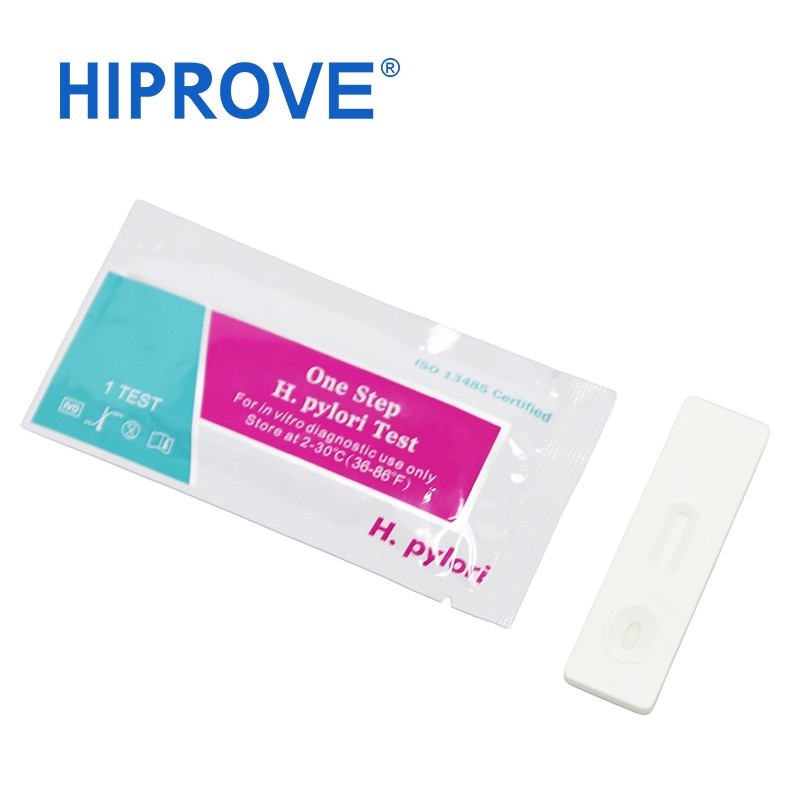
Most of the company's products can provide a full range of customized services including product materials, models, functions, packaging. Please contact customer service staff for details.
Through more than ten years of medical and health product export services, we have accumulated a wealth of industry experience, and can provide professional and personalized services to meet the needs of different customers around the world for personalized and branded customized medical products.
| Type: | One Step H. pylori Antigen & Antibody Rapid Test Cassette | Brand Name: | Hiprove |
| Origin: | China | Model NO.: | YL1 |
| Packing: | Individual Pack (1PC/Bag, 20PCS/Box) | Function: | Screening of H. pylori Infection |
| Classification: | Rapid Test Kit (IVD) | Customization: | Available (ODM/OEM) |
| Test Type: | Antigen Test, Antibody Test | Specimen: | Whole Blood, Serum, Plasma, Feces |
| Certification: | CE, FDA, ISO13485 | Group: | All |
| Use Type: | in Vitro Diagnostic Use | Storage Condition: | Room Temperature |
| MOQ: | 10000 PCS | Delivery Date: | 35 Days |
| Transport Package: | Individual Pack | Specification: | 1 pc/pack, 20pcs/box |
| Trademark: | Hiprove | Production Capacity: | 20000 PCS/Week |
One Step H. pylori Antigen & Antibody Rapid Test Cassette (Specimen: Stool/Whole Blood/Serum/Plasma)
【Product Overview】
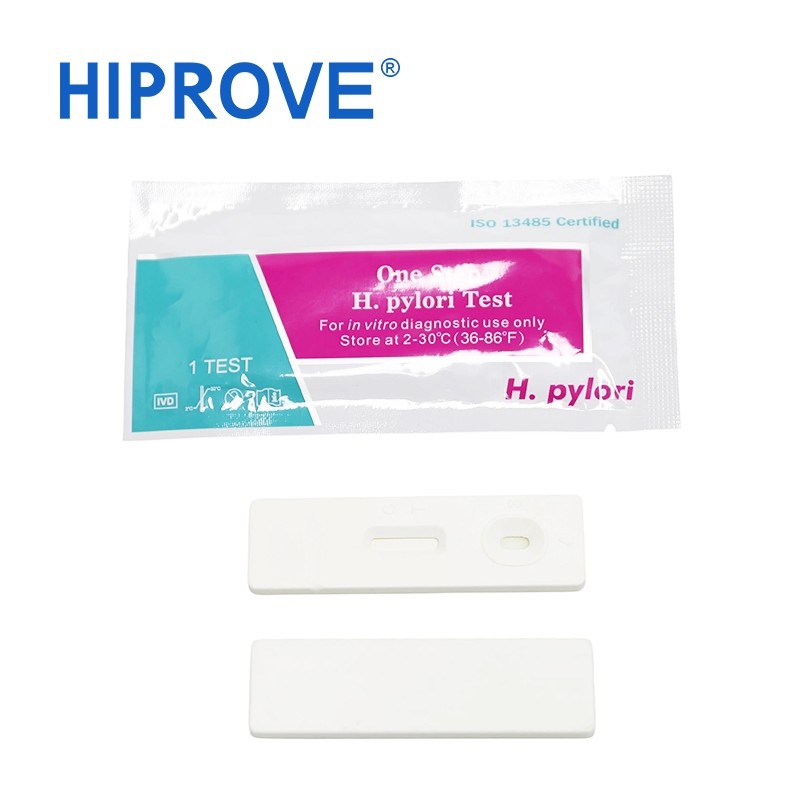
This is a one-step Helicobacter pylori (H. pylori) rapid test kit based on colloidal gold immunochromatography, available as an Antigen Test and an Antibody Test, compatible with multiple specimen types including stool, whole blood, serum and plasma, for the auxiliary screening of H. pylori infection. H. pylori is a Gram-negative spiral bacterium closely associated with chronic gastritis, peptic ulcer and gastric cancer (classified as a Group 1 carcinogen by the IARC of WHO). The test is simple, instrument-free, and suitable for in vitro diagnostic use in clinical institutions as well as home and clinic screening.
【Two Test Types and Their Clinical Significance (Important Difference)】
· Antigen Test (stool specimen): uses monoclonal antibodies to detect H. pylori-specific antigens in stool, directly indicating the presence of the bacteria. Its sensitivity and specificity approach those of the urea breath test (≥90%). It can be used to judge active infection and to monitor eradication efficacy, and is especially suitable for children, the elderly and those unable to perform the breath test.
· Antibody Test (whole blood/serum/plasma specimen): detects H. pylori-specific antibodies (IgG/IgM/IgA) produced after infection. Antibodies usually appear weeks after infection and may remain positive for months to years even after the bacteria are eradicated. Therefore a positive antibody result only indicates a past or present infection and cannot distinguish active from past infection. It is suitable for epidemiological surveys and preliminary screening, and is not recommended alone for efficacy evaluation. Subjects with a positive antibody result should be confirmed for active infection by urea breath test or stool antigen test.
The two test types differ in clinical significance — please select the appropriate type and specimen according to the actual testing purpose.
【Test Principle】
Based on colloidal gold immunochromatography. The antigen test uses a double-antibody sandwich assay: the test line (T) is coated with anti-H. pylori specific antibody and colloidal gold is conjugated with another monoclonal antibody; H. pylori antigen in the sample binds the gold conjugate and is captured at the T line to develop a colour. The antibody test uses a double-antigen sandwich (or indirect) assay: the T line is coated with H. pylori-specific antigen, and antibodies in the sample are captured with the gold-labelled antigen/anti-antibody. The control line (C) develops regardless of whether the target is present, verifying proper flow and sufficient sample volume; no C line means the test is invalid.
【Result Interpretation】
Positive: both C and T lines appear (two lines); any T line intensity, however faint, is positive;
Negative: only the C line appears (one line), no T line;
Invalid: no C line appears — incorrect operation or reagent failure; repeat with a new cassette.
【Procedure (Summary)】
Add the specified number of drops of the specimen (stool suspension/whole blood/serum/plasma, according to the test type) into the sample well and read the result after a few minutes (as stated in the instruction sheet). For the stool antigen test, the stool sample must be prepared according to the instructions. Follow the enclosed instructions strictly.
【Product Features】
· One-step rapid test, simple operation and easy result interpretation;
· Supports both antigen and antibody tests for flexible detection needs;
· Compatible with multiple specimen types: whole blood, serum, plasma and stool;
· Qualitative screening of H. pylori infection with stable, reliable performance;
· Compact cassette design for simple storage and transportation; individually sealed foil pouch keeps the strip uncontaminated;
· Suitable for clinical institutions and home self-screening; compliant with IVD in vitro diagnostic requirements.
【Storage & Package】
Store at room temperature (2-30℃ as printed on the pouch; see instruction sheet); individually packed, 1 pc/bag, 20 pcs/box; MOQ 10000 pcs, delivery 35 days, production capacity 20000 pcs/week; ODM/OEM customisation available.
【Precautions】
1. For in vitro diagnostic use and H. pylori infection screening only. Results should be interpreted by a physician together with clinical findings; a positive antibody result should be confirmed for active infection by urea breath test or stool antigen test;
2. Use of antibiotics or bismuth within one month, or proton pump inhibitors (PPI) within one week, may suppress the bacteria and cause false-negative antigen/breath test results; serological antibody tests are less affected by recent medication;
3. Follow the instructions and reading time strictly; insufficient sample volume or reading too early/too late may cause inaccurate results;
4. Antigen and antibody tests use different specimen types — do not mix them. Handle all specimens as potentially infectious and dispose of used devices according to local medical waste regulations;
5. Single use only; do not use after the expiry date.